
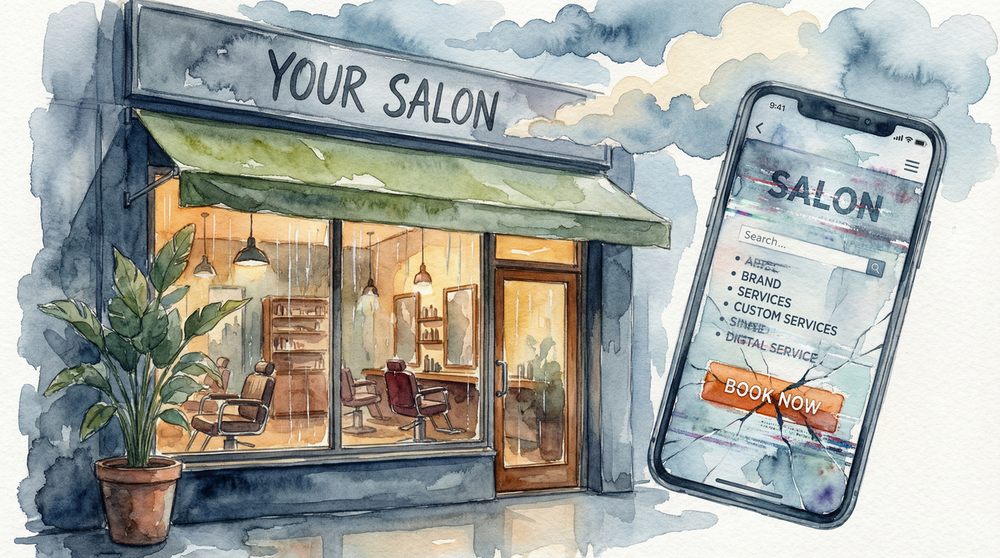
Your website gets traffic. Google Analytics proves it. But those visitors aren’t becoming appointments.
The problem isn’t your salon’s quality. It’s not your stylists’ skills or your service menu. The problem is conversion—the gap between someone landing on your site and actually booking with you.
Here’s the uncomfortable truth: 94% of salon clients want online booking capabilities. Yet only 53% of salons offer it. That gap represents thousands of lost bookings every single day.
Most salon websites were built by web designers who’ve never run a salon. They created something that looks pretty but doesn’t convert. This post breaks down exactly why that happens—and how to fix each problem.
The Mobile Booking Crisis
Here’s a stat that should terrify you: 67% of salon website visits happen on mobile devices. Yet most salon sites were designed for desktop first.
On mobile, every extra tap costs you conversions. Every pinch-to-zoom loses attention. Every slow-loading image creates doubt.
What Mobile Visitors Actually Experience
Most salon websites were designed on desktop computers by people who never tested them on phones. The result is a mobile disaster disguised as a professional website.
Text that’s too small to read without zooming. Buttons positioned where thumbs can’t reach them. Forms that require typing an essay to book a simple haircut.
Every friction point costs you bookings. Mobile visitors give you about three seconds before they bounce to a competitor whose site actually works.
The Thumb Zone Problem
Phone users navigate with their thumbs. There’s a natural arc of easy-to-reach screen space called the “thumb zone.”
Your most important actions—booking and calling—need to live in that zone. If customers have to stretch to the top corners or use two hands, you’re making conversion harder than it needs to be.
Most salon websites bury booking buttons in headers or hide them in hamburger menus. That’s conversion suicide on mobile.
Three Seconds to Load or Three Seconds to Lose
Google’s research is brutal: 53% of mobile visitors abandon sites that take longer than three seconds to load.
You’re not just losing those visitors. You’re losing them to the competitor whose site loads instantly. They click back to Google and choose the next result.
Test your site speed at PageSpeed Insights. If you’re not scoring 90+ on mobile, you’re bleeding bookings daily. (For a complete speed optimization guide, see how to fix your slow website.)
Images are usually the culprit. Unoptimized photos from phones or cameras can be 5-10MB each. Every megabyte adds loading time and costs you bookings.
The Booking Button Nobody Can Find
You’d be amazed how many salon websites make booking nearly impossible. The owner knows exactly where the booking link is. Their customers don’t.
Your Phone Number is Playing Hide and Seek
Test this right now: Can someone find your phone number in under three seconds?
If it’s buried in a footer or hidden on a contact page, you’re losing calls. Mobile visitors especially need immediate access to call you.
Put your phone number in the header of every page. Make it clickable on mobile so one tap starts the call. Remove every barrier between interest and action.
When Salon Afton restructured their site to make contact instant, phone bookings jumped 34%. The change took 10 minutes to implement.
Above the Fold or Below the Grave
“Above the fold” means the content visible without scrolling. Your booking option needs to be there, obvious, and compelling.
If visitors have to scroll through your welcome message, your salon story, your philosophy, and three staff profiles before finding how to book—most won’t make it.
The booking call-to-action should be visible within one second of landing on any page. Not after reading, not after scrolling, immediately.
Online Booking: The Feature 46% of Salons Still Don’t Offer
82% of clients search for salons on their phones. They’re often searching during downtime—lunch breaks, commutes, late evenings. They don’t want to call during business hours.
Online booking captures these after-hours visitors. It turns 11 PM browsing into 9 AM appointments. Without it, you’re hoping they remember to call tomorrow.
The resistance usually sounds like this: “My clients prefer calling.” But preference data says otherwise. Given the choice, most clients book online when it’s available.
Add a booking button above the fold on every page. Make it the most prominent element in your navigation.
Contact Forms Are Not Booking
Some salon websites offer only a contact form for booking. “Fill out this form and we’ll get back to you.”
That’s not booking. That’s lead generation from 2008.
Modern clients expect to see availability and book immediately. A contact form feels like a barrier, not a service. You’re asking them to wait for a response when competitors let them book instantly.
Outdated Information Destroys Trust
Nothing tanks credibility faster than wrong information on your website. Old hours, departed stylists, discontinued services—these mistakes cost you more than you realize.
The Hours Mismatch Problem
A potential client checks your website at 7 PM on a Thursday. Your site says you’re open until 8. They drive over and find you closed because you changed your hours six months ago but never updated the website.
You just lost that client forever. Not because of bad service—you never got the chance to provide service. You lost them because your website lied.
Ghost Staff Members
Former employees still displayed on your website create an awkward experience. Clients book expecting Sarah. Sarah left three months ago.
Now your front desk has to manage disappointment before the appointment even starts. The client feels misled. You’ve damaged trust before delivering any service.
Price Transparency Builds Trust
“Call for pricing” creates friction and doubt. Clients wonder if you’re hiding expensive rates. They suspect bait-and-switch tactics. They call competitors who list prices instead.
Nobody expects exact quotes online. Hair varies, techniques vary, results vary. But price ranges show you’re honest and professional.
List starting prices or price ranges for every service. Explain what affects the final cost—hair length, density, condition. Help clients self-qualify before they call.
This filters out price shoppers and attracts clients who value your work. It also increases booking confidence because clients know roughly what to expect.
And if you do list prices, keep them current. Outdated numbers that don’t match checkout reality create friction at the worst possible moment. Clients feel ambushed.
Service Pages That Actually Convert
Your homepage can be perfect. But if service pages don’t answer questions, visitors won’t book.
Think of service pages as individual landing pages. Each one needs to convince visitors that this specific service is right for them.
Vague Descriptions Equal Lost Bookings
“We offer haircuts, color, and styling” doesn’t help anyone decide. It’s like a restaurant menu that just says “we serve food.”
Clients searching for “balayage near me” want to know your balayage process. They want to see before-and-after photos. They want to understand what makes your approach different.
Write dedicated pages for each major service. Explain the process, timeline, and results. Show portfolio photos specific to that service. Answer the questions clients ask before they book.
When Salon Afton rewrote their service pages with specific details, organic bookings increased 67%. The content was already in their stylists’ heads. They just had to put it on the site. This kind of content also feeds Google’s AI recommendation systems that surface tips to potential clients.
The Questions Nobody Answers
What’s your cancellation policy? Do you require deposits for color services? How long does a balayage appointment actually take? Do you work with curly hair? Can I bring my kid?
These aren’t edge cases. These are the questions running through every potential client’s mind. If they can’t find answers, they have to call—and most won’t bother.
FAQ Sections Actually Work
A well-organized FAQ section does more conversion work than most salon owners realize. It removes objections, sets expectations, and builds confidence.
The key is anticipating real questions, not the questions you wish people would ask. “Do you use premium products?” matters less than “What happens if I need to reschedule?”
No Social Proof, No Trust
Your website says you’re amazing. Every salon’s website says they’re amazing. Why should anyone believe yours?
Potential clients don’t know you yet. They need proof you’re legitimate, skilled, and safe to trust with their hair. Your website should answer their doubt before they even ask the question.
Your Google Reviews Belong On Your Site
You worked hard to build those Google reviews. They prove your expertise. But if visitors have to leave your site to see them, many never will. (If you need more reviews first, here’s how to get 100 Google reviews in 90 days.)
Embed your Google Business Profile directly on your homepage. Show your rating, review count, and recent reviews without requiring visitors to click away.
This single change can increase conversion rates by 15-25%. You’re using social proof you already earned—you’re just making it visible where decisions happen.
Visitors see reviews, map location, hours, and photos in one place. Everything they need to trust you is right there. No extra searching required.
Reviews That Tell Stories
Generic five-star ratings don’t tell the full story. Descriptive reviews do.
When past clients explain your color correction expertise or consultation process, new clients visualize their own experience.
Ask clients to mention specific services in their reviews. “The balayage was perfect” tells a better story than “great service.” Descriptive reviews demonstrate specific expertise.
Display these reviews prominently on service pages. When someone’s researching balayage, show them balayage reviews right there. Match proof to intent.
The Before-and-After Gap
Salon work is visual. Clients want to see what you can do, not just read about it. A gallery of your actual work builds more trust than any amount of written promises.
Before-and-after photos are especially powerful. They show transformation—exactly what potential clients are hoping you’ll deliver for them.
Measuring What Actually Matters
You can’t fix conversion problems you can’t measure. Start tracking the right metrics.
Google Analytics shows traffic sources and page views. But you need conversion tracking too. How many visitors book? How many calls? Where do they drop off?
Set up goals for bookings, phone clicks, and contact form submissions. Track which pages convert best. Find where you’re losing people.
This data reveals your specific problems. Maybe mobile traffic converts at half the rate of desktop. Maybe your color page gets traffic but no bookings. Each metric points to a fix.
How Salons Actually Fix This
The problems are clear. The solutions require either consistent manual effort or the right systems.
The Manual Approach
You can fix everything mentioned above yourself. Update your hours immediately when they change. Remove former staff members promptly. Add FAQ answers as questions come up.
This approach works if you’re disciplined. Most salon owners aren’t—not because they’re lazy, but because they’re busy doing hair. Website maintenance falls to the bottom of an endless list.
The manual approach typically results in a two-week burst of updates followed by six months of neglect.
The Systems Approach
Successful salons build systems that make updates automatic or effortless. They don’t rely on remembering to update the website; they make updates a natural part of their workflow.
Some use team members with specific website responsibilities. Others use tools that simplify the update process to something that takes seconds rather than minutes.
The key is reducing friction. If updating your hours requires logging into a dashboard, navigating menus, and editing code—it won’t happen consistently. If it takes fifteen seconds via text message, it happens every time.
The Conversion Audit
Before fixing anything, know what’s actually broken. Pull up your website on your phone. Time how long it takes to load. Count the taps required to book.
Check your hours, staff list, and prices against reality. Look for outdated information anywhere on the site.
Ask five friends who’ve never seen your website to find your booking button. Time them. Their confusion reveals your blind spots.
The Compound Effect of Small Fixes
Fixing your salon website may not require a complete rebuild. Start with the highest-impact changes first.
Add a prominent phone number and booking button today. Test your mobile experience tomorrow. Improve service descriptions next week. Each fix compounds.
A client who couldn’t book on mobile goes elsewhere. A client who found wrong hours loses trust. A client who couldn’t find answers found a competitor who provided them. These aren’t dramatic failures—they’re quiet losses you never knew happened.
The good news: fixing these issues compounds too. A faster mobile site that clearly displays booking, accurate information, helpful answers, and real social proof doesn’t just fix individual problems. It creates a website that actually converts visitors into appointments.
Salon Afton didn’t transform overnight. They made systematic improvements over 24 months. The result was 1,000%+ ROI and complete local market dominance—but it started with fixing one conversion barrier at a time.
Your website can be your hardest-working employee—greeting every potential client, answering their questions, and booking their appointments around the clock. Or it can be an expensive digital brochure that looks nice but drives clients to competitors who took their website seriously.
The difference is rarely about design. It’s about function, accuracy, and removing every obstacle between “I need a haircut” and “appointment booked.”
Want to see how Salon Afton rebuilt their digital presence to capture every possible booking? We documented their entire process—from fixing basic conversion issues to becoming the #1 salon in their market. The strategies work whether you implement them yourself or need help making it happen. Let’s talk about what’s possible for your salon.


