
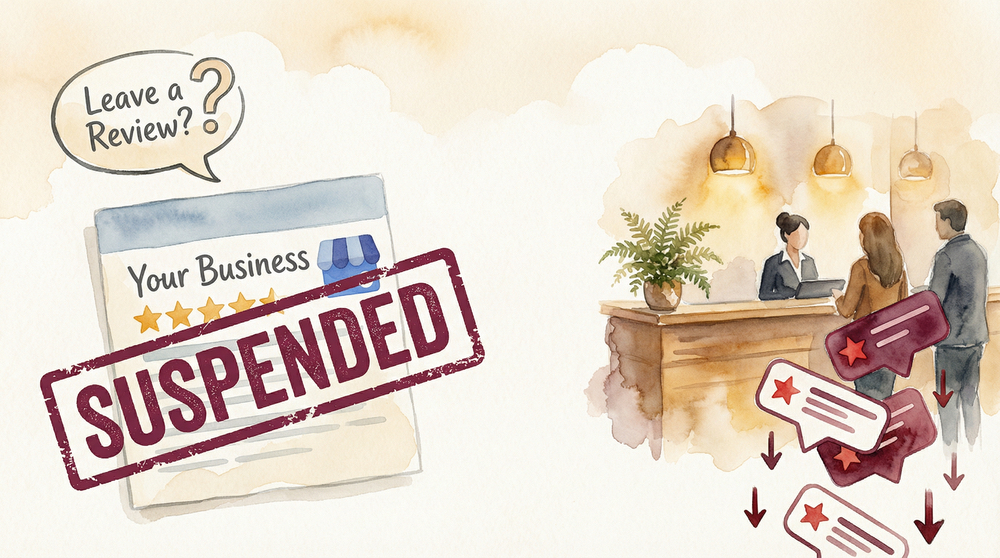
A salon owner woke up to 800 missing reviews. One day she had 1,200 five-star ratings. The next morning? 400.
Then came the official notice. Google restricted her Business Profile for 30 days. No new reviews allowed. A warning banner now tells potential clients that “suspicious reviews were removed.”
Her mistake? Asking clients for reviews while they checked out at the register.
Google considers this pressure. And they’re actively enforcing their policies against it. Reports from Google Product Experts suggest this pattern is becoming increasingly common across the beauty industry.
What’s Actually Happening to Salon Profiles
Google Product Experts are reporting a wave of enforcement actions. Salons are losing hundreds of reviews overnight. Business Profiles are being restricted. Warning banners are appearing on affected listings.
This enforcement comes after regulatory pressure. The UK’s Competition and Markets Authority forced Google’s hand. The FTC introduced new rules in the US. Now Google has to prove they’re serious about fake engagement.
The 30-Day Restriction
When Google catches you, they don’t just delete reviews. They freeze your entire review system for 30 days minimum.
During this period, no client can leave a review. Your profile displays a warning banner. Your average rating drops because you lost reviews.
New clients see that warning. They wonder what happened. Some choose a competitor instead.
The Warning Banner That Kills Trust
That banner is brutal. It tells everyone that Google removed suspicious reviews from your business.
Potential clients don’t know the details. They just see “suspicious” and “removed.” That’s enough to create doubt.
You can’t remove the banner. You can’t explain what happened. You just wait 30 days and hope your reputation recovers.
Why Checkout Review Requests Cross the Line
Google’s Fake Engagement Policy is clear. You cannot pressure customers to leave reviews. You cannot incentivize them. You cannot ask at the point of sale.
The register is the point of sale. That’s where money changes hands. That’s where the power dynamic is clearest.
The Pressure Problem
Think about the psychology. Your client just finished their service. They’re standing at the register with their credit card out.
The stylist or receptionist asks for a review right then. What’s your client supposed to say? “No, I don’t want to help your business”?
Most people feel obligated. Some feel uncomfortable. But they pull out their phone and leave a review because saying no feels awkward.
That’s not genuine feedback. That’s coercion. Google knows the difference.
What Google’s Policy Actually Bans
The Fake Engagement Policy prohibits three specific actions. Don’t offer incentives like discounts or freebies for reviews. Don’t discourage negative feedback or only ask for positives. Don’t pressure people at the moment of transaction.
Asking at checkout violates the third rule. It doesn’t matter if you’re nice about it. It doesn’t matter if you don’t offer anything in return.
The location and timing create pressure. That’s enough for Google to take action.
How Google Actually Detects This Practice
While Google relies on manual reports from consumers, it also uses algorithmic detection. Their systems look for patterns that indicate policy violations.
Two signals are particularly powerful. Review timestamps and Business Profile traffic data. When these correlate suspiciously, Google investigates.
The Time Correlation Signal
Your Business Profile shows when your salon is busiest. Google tracks foot traffic patterns for every location.
They also know exactly when reviews are posted. If your review timestamps consistently match your busiest hours, that’s a red flag.
Think about it. Real reviews don’t happen during the appointment. Clients leave reviews later—that evening, the next day, sometimes a week after.
But reviews solicited at checkout? They happen immediately. Right during business hours. Right when the salon is packed.
The Pattern Recognition Algorithm
Google’s AI looks for unnatural patterns. A salon with consistent review volume suddenly sees a spike. Reviews cluster at specific times. Multiple reviews appear within minutes of each other.
These patterns scream “solicited at checkout.” The algorithm flags your profile. A human reviewer confirms. Then the penalties begin.
The sophistication is impressive. Google can detect which businesses ask at checkout versus which use proper post-visit follow-up.
The Right Way to Generate Salon Reviews
You can and should ask for reviews. You just can’t do it at the wrong time in the wrong place.
The solution is simple. Wait until after they leave. Send a follow-up message. Make the review process effortless. (For a complete system that can help you get 100 Google reviews in 90 days, see our detailed guide.)
Wait Until After They Leave
Give your client space. Let them get home. Let them see their new hair in different lighting. Let them get compliments from friends.
That’s when they’re genuinely excited. That’s when their review reflects real experience. That’s what Google wants to see.
Send a text or email 2-4 hours after their appointment. This timing feels natural. It’s enough space to avoid pressure, but soon enough that the experience is fresh.
Make It Effortless, Not Pushy
Your follow-up should do two things. Thank them for their visit. Provide a direct review link.
That’s it. No more than 2 requests. No guilt trips. No explanations of why reviews matter.
The message should feel like a friendly thank you. The review link should go directly to your Google Business Profile. One click and they’re there.
And definitely no review gating.
Review gating is when you screen clients before asking for reviews. You send the review link only to happy clients. Unhappy clients get sent to a private feedback form instead.
Some services do this automatically. They ask “How was your experience?” with a thumbs up/thumbs down. If the client chooses thumbs up, they get the Google review link. Thumbs down? They’re redirected to a complaint form.
Google explicitly bans this practice. They call it “discouraged or prohibited content” in their Fake Engagement Policy. The reason is simple—it artificially inflates your rating by filtering out negative feedback.
Send every client the same review link. Don’t pre-screen. Don’t filter. Let them choose what to say.
If someone had a bad experience, you want to know about it publicly. That’s how you improve. That’s how you build real trust. And that’s what keeps your Business Profile in good standing with Google.
A Simple Text That Works
Here’s the exact message Salon Afton used to grow from 154 to 988 reviews. “Thanks for visiting today! We loved seeing you. If you have a moment, we’d appreciate your feedback: [direct review link]”
Notice what’s missing. No pressure. No request for five stars. No explanation of how reviews help. Just gratitude and an easy path to leave feedback.
This simple approach generated 834 new reviews in 24 months. Zero penalties. Zero deleted reviews. Just genuine client feedback.
What This Means for Your Business
This crackdown isn’t temporary. Google has regulatory pressure to maintain review integrity. They’re going to keep detecting and punishing pressure-based solicitation.
If you’re currently asking at checkout, stop immediately. Switch to post-visit follow-up today. The risk isn’t worth it.
The Trust Factor
Reviews only work if clients trust them. When Google removes 800 reviews and adds a warning banner, that trust evaporates.
You can’t rebuild trust quickly. Those deleted reviews are gone forever. The warning banner stays for 30 days minimum.
New clients don’t care why it happened. They just see suspicious activity and choose someone else. Your ranking drops. Your booking rate falls. Revenue suffers.
Building Review Volume the Right Way
Salon Afton proves the right approach works better anyway. They generated 988 reviews with zero policy violations using a systematic approach to review generation. Their profile ranks #1 for 88% of local searches.
Their secret? A systematic post-visit text sent 2-4 hours after every appointment. The message was friendly and brief. The review link was direct.
Result? 541% review growth over 24 months. $70K+ in attributed revenue. 1,000%+ ROI. And zero penalties from Google.
That’s the power of doing it right. Patient, systematic, pressure-free review generation that Google rewards instead of punishes.
Take Action Before Google Finds You
If you’re asking at checkout, change your process this week. Set up automated follow-up texts or emails. Train your team to stop soliciting reviews in person.
The penalties are real. The enforcement is accelerating. And the damage to your business can take months to repair.
Want to see how Salon Afton built their review system without violating any policies? We documented their entire process—from the text messages they send to the timing that maximizes response rates.
Reach out, and we’ll walk you through what actually works.


